1 / 7
Reflection of light
PRISM chapter 1 “Reflect”
Reflection of light happens when light hits a surface, such as a mirror, and bounces back off it in a new direction; on a smooth surface the angle of reflection equals the angle of incidence.
A small experiment
All you need is a hand mirror and a flashlight. It works best in a slightly darkened room.
- Lay the hand mirror flat on a table. Hold the flashlight at a slant and shine it at the middle of the mirror. Find the bright spot on the ceiling or a wall.
- Slowly tilt the flashlight more upright, then lower it again. Watch which way the spot moves.
- Now keep the flashlight still and lift the edge of the mirror nearest the flashlight a little by sliding an eraser under it. What happens to the spot?
Safety: never shine the flashlight, or light bounced off the mirror, into anyone's eyes. If you hold the flashlight nearly upright, the reflection comes straight back up towards you, so keep your face away from above the mirror. Do not use a cracked mirror.
What happened?
Light travels in straight lines. When it hits the mirror it cannot pass through, so it bounces off in a new direction. This is reflection. The spot on the ceiling is where the reflected light lands. Cover the mirror with your hand and the spot disappears.
When you tilted the flashlight, the spot moved. If the light going into the mirror changes direction, the light coming out changes direction too. The more upright the flashlight, the closer the spot comes to the point straight above the mirror. The lower the slant, the further the spot moves away, on the side opposite the flashlight.
Lifting the mirror moved the spot as well, even though the flashlight stayed still. Change the way a mirror faces and you change where the reflected light goes. That is exactly what you do when you tap a mirror in the game.
Try shining the light on a sheet of white paper instead of the mirror. No sharp spot appears on the ceiling. Under a microscope, the surface of paper is bumpy, so it scatters the light in many directions. This is also how we see things that make no light of their own, like a book or a face: light bounces off them into our eyes. Because that light is scattered in every direction, you can see the object from anywhere in the room.
Going further (ages 11 to 14): the law of reflection
At the point where the light hits the mirror, draw a line at right angles to the mirror surface. This line is called the normal. The angle between the incoming ray and the normal is the angle of incidence. The angle between the reflected ray and the normal is the angle of reflection.
The law of reflection: the angle of incidence always equals the angle of reflection. The incoming ray, the reflected ray and the normal also all lie in the same flat plane. Even on rough paper, each tiny bump still obeys this law; the bumps just face every which way.
- Measure both angles from the normal, not from the mirror surface. Mixing these up is a very common mistake.
- Shine light straight at a mirror, along the normal, and the angle of incidence is 0 degrees. The angle of reflection is 0 degrees too, so the light goes straight back the way it came.
- Turn a mirror by some angle and the normal turns with it, so the reflected ray turns by twice that angle. That is one reason lifting the mirror just a little moved the spot so far in step 3. The other is distance: the further away the ceiling, the further the spot moves for the same angle.
Measure it on paper. Cover the front of the flashlight with card, leaving only a thin slit, to make a narrow beam. Stand the mirror upright, at right angles to the paper, and draw a pencil line along its back (silvered) face. Shine the beam so that it skims across the paper to the mirror. Trace the incoming and reflected beams in pencil, draw the normal, and measure both angles with a protractor. They should match to within a few degrees.
In the game
PRISM, a light puzzle game by A Driven, begins with mirrors in chapter 1, “Reflect”. The boards in this chapter have only three kinds of piece: light sources, mirrors and crystals. A light source fires a red, green or blue beam in one direction. A crystal lights up when it receives light of its own color. Light every crystal and the board is solved.
Each mirror sits diagonally in one square of the grid. Tap it and it turns 90 degrees, switching between a “/” shape and a “\” shape. Those are its only two positions. Beams only travel up, down, left or right, so they always meet a mirror at 45 degrees and always turn through a right angle. Which way they turn depends on which way the mirror leans.
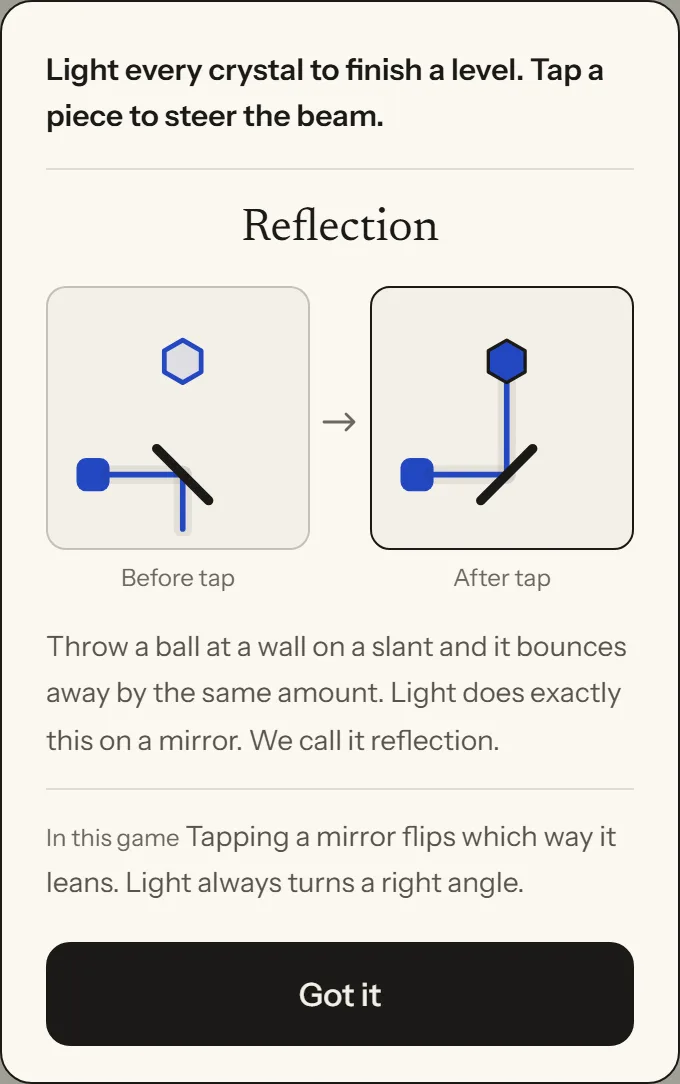
In terms of the law of reflection, the angle of incidence and the angle of reflection are both 45 degrees, which puts a right angle between the beam going in and the beam coming out. And when the mirror turns 90 degrees, the reflected beam turns twice as far, 180 degrees. On the card above, a beam heading down heads up after a single tap.
You can play all 14 boards of chapter 1 in a web browser, with nothing to install and no sign-up. In class, ask students to say which way the beam will turn before they tap. Predicting where reflected light will go is the skill this page is about.
Check your understanding
You shine a flashlight straight at a mirror, at right angles to its surface. Where does the reflected light go?
Straight back towards the flashlight, along the path it came in on. The light arrives along the normal, so the angle of incidence is 0 degrees, and the angle of reflection is 0 degrees too.
A ray hits a mirror with an angle of incidence of 30 degrees. What is the angle of reflection? What is the angle between the incoming ray and the reflected ray?
The angle of reflection is 30 degrees. Both angles are measured from the normal, on opposite sides of it, so the angle between the two rays is 30 + 30 = 60 degrees.
In PRISM, a beam heading right meets a mirror shaped like “/”. Which way does it go? And after one tap?
It turns and heads up. After one tap the mirror becomes “\” and the beam heads down instead. Either way it turns through 90 degrees, because it meets the mirror at 45 degrees.
Where the game differs from real light
- A real mirror reflects light arriving at any angle, always with the angle of reflection equal to the angle of incidence, and you can turn it a little at a time. In the game, beams only travel up, down, left or right, and a tap swaps the mirror between its two positions 90 degrees apart, so light always turns through exactly 90 degrees.
- A household mirror is a sheet of glass with a thin metal coating on the back, painted over, so only one side works as a mirror. Mirrors in the game reflect light from both sides.
- A real mirror absorbs a little of the light, so the reflected light is slightly dimmer than the light that went in. The game does not track brightness, and a mirror never changes the color of a beam.
- In real life almost every surface reflects some light, and rough surfaces scatter it in many directions. In the game, only mirrors and the half-silvered mirrors of chapter 2 reflect light; crystals, light sources and walls absorb whatever reaches them.
Keep going
- Printable worksheet: Path of Light
- Play chapter 1 of PRISM in your browser